
INTRODUCTION TO CLOUD COMPUTING
This blog is an excerpt from a live training session of the ABC OF CLOUD COMPUTING (CLOUD COMPUTING EMPOWERMENT) 2025 cohort.
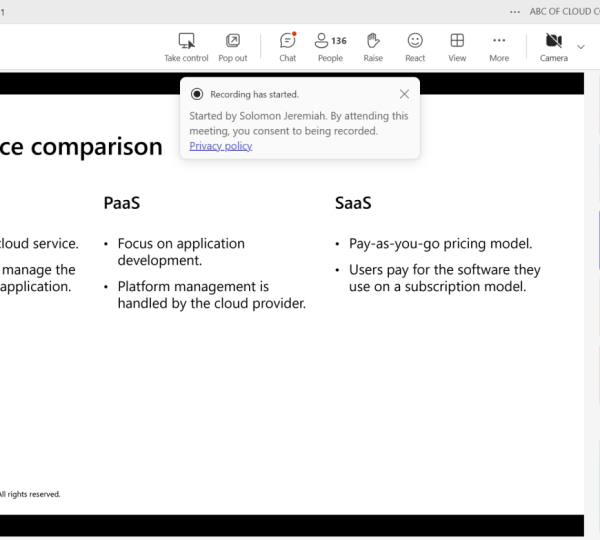
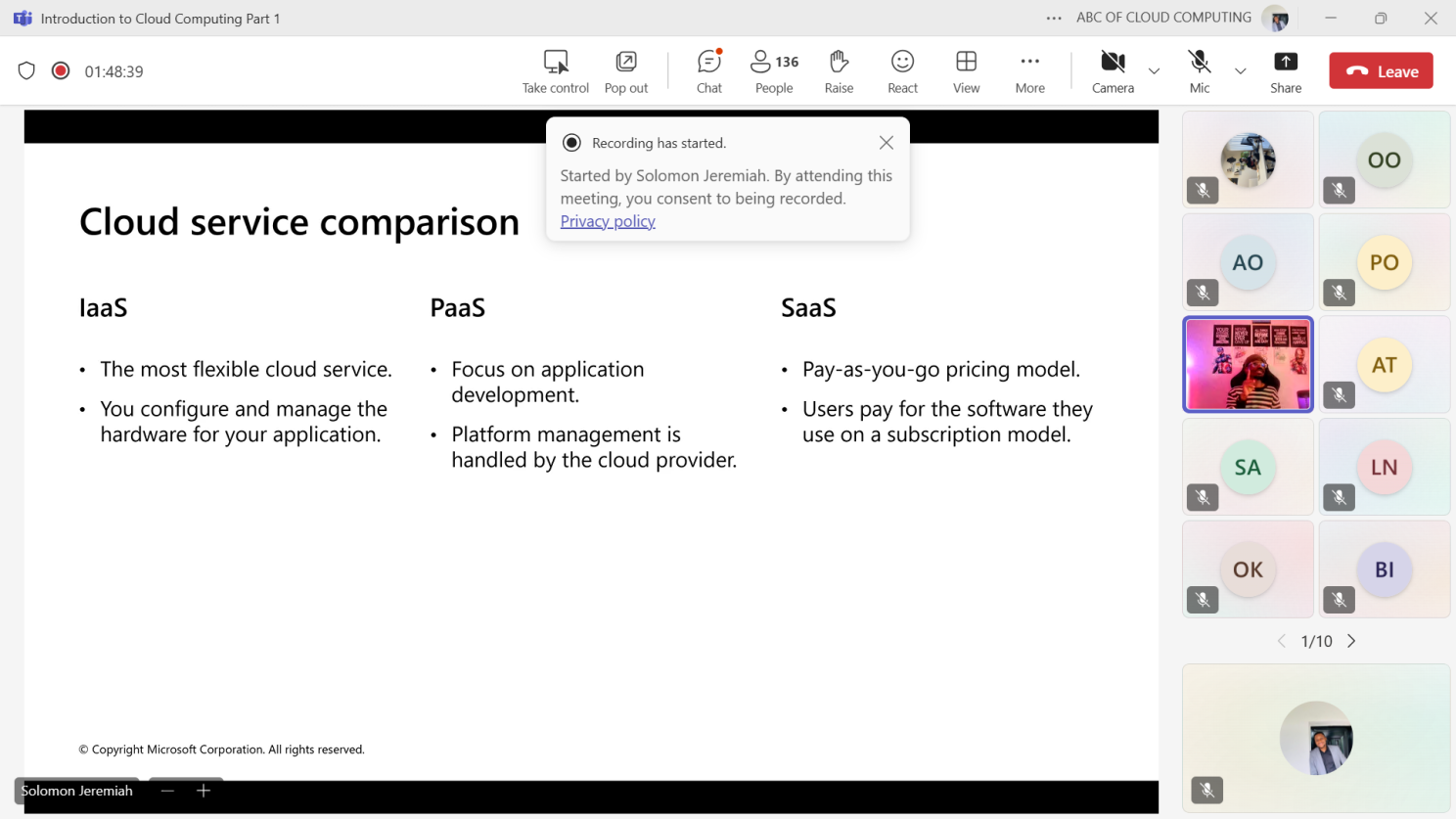
Teams Attendees
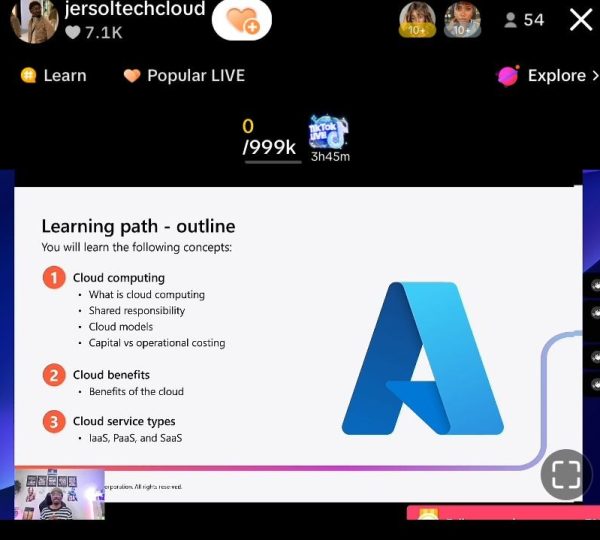
TikTok Attendees
With a total number of 190 students in attendance ( 136 teams users and 54 tiktok live attendees), Solomon Francis Jeremiah took the students on a foundational overview of Cloud Computing starting from the question, “what is cloud computing?”
WHAT IS CLOUD COMPUTING?Cloud computing is the delivery of computing services over the internet. The most important thing to note here is that, computing services are delivered over the “internet”. These services include traditional IT services like deployment of servers, storage, virtual machines, networking, etc. This services is not just limited to traditional IT services, but also extends to other computing services like enabling AI-driven solutions, machine learning, internet of things (IoT), digital transformation, automation, and global-scale applicationsacross multiple industries. This allows businesses and individuals to access and manage resources on-demand, without needing to own or maintain physical infrastructure or constrained by the limitation of traditional data centres.
WHAT ARE CLOUD DEPLOYMENT MODELS?Cloud deployment models otherwise known as “cloud types” define the different ways cloud services can be delivered. It is simple case of where and how the cloud is set up. There are three main types of cloud deployment models, however, 5 will be discussed below.
- Private Cloud: A private cloud is dedicated to a single organization and can be hosted on-premises or by a third-party provider. You can take this as a natural evolution of traditional datacentres. Private clouds enables organizations to have greater conrtrol over their cloud infrastructure. However, it is often more expensive to run, while also having fewer benefits as it is with public cloud.
- Public Cloud: a public cloud is owned and operated by a third-party provider and offers computing resources over the internet. These third parties are called Cloud Service Providers (CSPs). With a public cloud, anyone that wants to purchase cloud services can access and use resources. This is the distinction between a private and a public cloud. Some of the popular CSPs are Azure, Amazon Web Services (AWS), Google Cloud Partner (GCP)
- Hybrid Cloud: A hybrid cloud combines public and private clouds, allowing data and applications to move between them in an inter-connected enviroment. In this scenario, organizations can choose to extend cloud flexibility while still maintaning on-premises security. Meaning that, users can flexibly choose which services to keep in public cloud and which to deploy to their private cloud infrastructure.
- Multi Cloud: this is simply a process of using multiple cloud service providers. An example is an organization that uses both Azure and AWS to host their resources. Organizartions can choose to use certain services from different CSPs or to avoid vendor lock-in and improve reliability. Multi-cloud enviroment increases redundancy and fault tolerance, while also avoiding reliance on a single provider. Organizations can optimize services based on provider strengths
- Community Cloud: is a cloud computing model where the infrastructure is shared by multiple organizations with common interests, requirements, or regulatory concerns. It provides a balance between the security of a private cloud and the cost-efficiency of a public cloud.
Having understood cloud deployment models, let us compare IT infrastructure cost. When it comes to comparing IT infrastructure costs, there are two types of expenses to consider:
CapEx vs OpEx- Capital Expenditure (CapEx): capital Expenditures (CapEx) refer to the funds a company uses to acquire, upgrade, and maintain physical assets, such as buildings, technology infrastructure, and equipment. In the context of IT and cloud computing, CapEx involves large upfront investments in hardware, software, and data centers.
- Operational Expendditure (OpEx): OpEx is used to describe expenditure on services or products over time. This usuaully involves payment made for resources used at a time. Cloud Computing expenditure falls under OpEx because, you do not pay for the physical infrastructure and other capital expenditures needed to run a data centre. You only pay for the resources you use.
Having discussed the different IT infrastructure costs, it is also important to understand the consumption based model praticed in the cloud
WHAT IS CONSUMPTION BASED MODEL?A Consumption-Based Model is a cloud pricing strategy where users pay only for the resources they consume, rather than a fixed cost. This approach ensures cost efficiency, scalability, and flexibility by charging based on actual usage rather than pre-allocated resources. Some of the key characteristics of consumption based model includes:
- No Upfront Costs – There’s no initial investment in hardware or infrastructure.
- Avoid Unused Infrastructure – No need to purchase and manage expensive resources that may not be fully utilized.
- Scalable Resources – Pay for additional resources only when necessary.
- Cost Optimization – Stop paying for resources that are no longer in use.
The consumption based model in the cloud is very crucial because, it allows organizations to pay for only what they use. Meaning that, organizations do not need to overspend on buying infrastructures to scale like it occurs in traditional IT enviroments. Organizations can scale up and down without worries of wastage on resources when they are no more needed. This model also helps organizations plan aand make IT budgets without risk of overestimating cost or service failure from underestimating cost.
Having discussed the consumption based model of the cloud, let us explore advantages of using the cloud
BENEFITS OF CLOUD COMPUTING- High Availability: cloud computing ensures that services and applications are always accessible, minimizing downtime. With cloud providers offering data redundancy across multiple regions, users can continue to access services even in the event of hardware failures or outages. This allows for business continuity as services remain online even during disruptions. This is also enables global accessibility as users from different locations can access the services without interruption.
- Elasticity: elasticity refers to the cloud’s ability to scale resources up or down automatically based on demand. This flexibility ensures businesses only use the resources they need when they need them. This improves cost-efficiency as consumers only pay for what you use, avoiding overprovisioning. Elasticity also allows for dynamic adjustments as businesses quickly adapt to fluctuating workloads without manual intervention.
- Scalability: scalability enables cloud systems to accommodate increasing workloads by adding resources like storage, compute power, and network bandwidth. This ensures that as your business grows, your infrastructure can grow seamlessly. Scalability usually takes two forms; vertical and horizontal scaling.
- Reliability: Cloud platforms are designed for resilience and fault tolerance. They distribute workloads across multiple data centers to avoid single points of failure, ensuring that services are always available and function smoothly. This reduces downtime of services while also improving data recovery.
- Predictability: Cloud computing offers predictable costs through subscription-based or usage-based billing models. This allows businesses to better manage their budgets by estimating their cloud usage and corresponding expenses.
- Security: Cloud providers invest heavily in state-of-the-art security measures to protect data and applications. These include encryption, identity management, multi-factor authentication, and compliance with industry regulations. Cloud providers often meet global industry standards and regulatory requirements (e.g., GDPR, HIPAA).
- Governance: Governance in the cloud involves setting policies and procedures to ensure that resources are used properly, ethically, and in compliance with relevant laws. This is critical for ensuring security, cost management, and operational integrity.
- Manageability: Cloud platforms provide robust management tools and dashboards that allow businesses to easily monitor, maintain, and optimize their resources. This centralized management simplifies IT operations, ensuring that cloud environments are functioning efficiently. Manageability usually comes in two forms: management of the cloud and management in the cloud.
Now that we know the benefits of the cloud, let us discuss cloud service types:
CLOUD SERVICE TYPESCloud Service types also known as Cloud Service Models, define the level of management and control the CSPs and the customer have over cloud resources. There are three main types which we will discuss below.
- Infrastructure as a Service (IaaS): IaaS provides virtualized computing resources over the internet. The cloud provider manages the physical infrastructure, while users are responsible for managing operating systems, applications, and data. It offers the customer the most control over configuration and deployment of resources in the cloud. Examples are, virtual machines, storage, virtual networks, etc.
- Platform as a Service (PaaS): PaaS provides a platform allowing customers to develop, run, and manage applications without dealing with the underlying infrastructure. It abstracts the hardware and operating system management, providing tools for application development and deployment. This includes databases, and development frameworks. Examples are, Google App Engine, Microsoft Azure App Services, AWS Elastic Beanstalk.
- Software as a Service (SaaS): SaaS delivers fully managed applications over the internet. The cloud provider handles everything from infrastructure to software updates, and users access the software via a web browser or API. This offers the customer the least amount of control and customization as the bulk of the work depends on the CSP. With SaaS, you are essentially renting or using a fully developed application. While the SaaS model may be the least flexible, it’s also the easiest to get up and running. It requires the least amount of technical knowledge or expertise to fully employ. An example is M365.
Having understood the different Cloud Service Models, it is also important to compare these models in order to know which duties are to be performed by the CSP and customers depending on the service type.
SHARED RESPONSIBILITY MODELThe shared responsibility model describes what the customer takes responsibility for and what the CSP takes responsibility for. Click on the link below for this segment.
In conclusion, cloud computing has revolutionized the way businesses and individuals access and manage technology resources, offering unparalleled flexibility, scalability, and cost-efficiency. By understanding the various deployment models, service types, and consumption-based pricing, organizations can make informed decisions that align with their operational needs and strategic goals. With benefits such as high availability, security, and ease of manageability, cloud computing empowers businesses to innovate, adapt, and scale with minimal overhead. As technology continues to evolve, embracing the cloud is no longer just an option it is a vital component of achieving long-term success in an increasingly digital world.
Original Source: https://www.linkedin.com/pulse/copy-week-one-editorial-post-2025-cohort-abcofcloud-6y46f/
Written by: Felix Williams
Editor: Solomon Francis Jeremiah


